
Ask any industrial engineer and they’ll tell you – nozzles are the heart of any spray system.
But with so many types to choose from, how do you know whether a full cone nozzle or hollow cone nozzle is right for your application?
That’s exactly what we’ll cover in this complete guide.
By the end, you’ll know everything you need about full cone vs hollow cone nozzle to make the right choice.
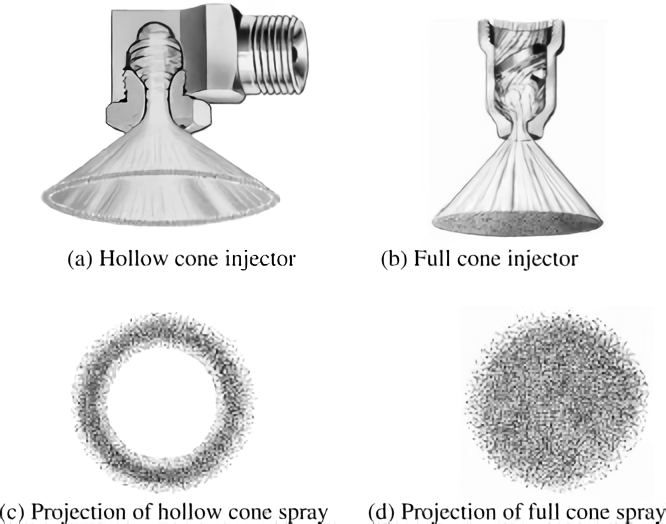
Full Cone Nozzle Overview
A full cone nozzle produces a spray pattern that’s evenly distributed across the entire cone.
Full Cone Nozzle Spray Pattern
When liquid passes through the nozzle, it’s forced into a circular rotation by internals veins. This spinning motion continues as it exits the nozzle orifice, resulting in a full, uniform circle of spray.
Full cone nozzles come in spray angles ranging from 30 to 170 degrees. The wider the angle, the larger the coverage area.
They generate medium to large size droplets compared to other nozzle patterns. These larger droplets provide good surface adhesion while still offering moderately high impact.
Hollow Cone Nozzle Overview
Unlike the full cone, a hollow cone nozzle concentrates liquid flow around the outer perimeter of the spray pattern.
Hollow Cone Nozzle Spray Pattern
This creates a signature “donut” shaped distribution with the finest droplet size of any hydraulic nozzle.
To produce this pattern, hollow cone nozzles utilize angled or spiral channels. As liquid passes through, it develops a strong rotational velocity. This centrifugal effect throws the liquid particles outward while drawing air into the empty core.
Hollow cone spray angles typically range from 40 up to 180 degrees. And because they operate at lower pressures, hollow cone nozzles consume less energy than full cones.
Full Cone vs Hollow Cone: Key Differences
Now that you understand how both nozzles work, let’s compare some of the key differences:
Spray Distribution
Full cone droplets cover the entire circular pattern for excellent area coverage with even distribution. Hollow cones focus liquid particles around the ring for lighter overall flow rates.
Winner: Full cone nozzle
Droplet Size
Smaller droplets from the hollow cone provide better absorption into gases and air. They also offer superior surface coverage. Larger full cone drops have higher adhesion and impact.
Winner: Hollow cone nozzle
Flow Rate & Pressure
At the same pressure, hollow cones emit a lower flow rate than full cones. And because hollow cone pressure requirements are lower, they consume less energy.
Winner: Hollow cone nozzle
Clogging Resistance
Full cone nozzles are more prone to clogging from particulates in the liquid stream. Hollow cone construction resists debris buildup better.
Winner: Hollow cone nozzle
Cost
Inexpensive hollow cone components keep replacement costs low. More complex full cone internals generally make them costlier to produce.
Winner: Hollow cone nozzle
Full Cone Nozzle Applications
With excellent area coverage, moderate impact, and uniform distribution, full cone nozzles work well for:
- General spray coating
- Surface cleaning
- Dust suppression
- Gas coolingtower packing spray
- Quenching hot objects
Certain full cone designs also offer exceptional resistance to abrasive slurries.
Hollow Cone Nozzle Applications
The superb liquid atomization from hollow cone nozzles make them ideal choice for processes requiring:
- Humidification
- Oil burners
- Gas conditioning
- Moistening
- Mist cooling
- Applying thin films
The extended spray reach of wide-angle hollow cones also suits them for spray chambers and tower scrubbers.
Full Cone vs Hollow Cone Nozzle: Which is Better?
When choosing between full and hollow cone nozzles, there’s no definitively “better” option.
The right selection comes down to matching attributes of each nozzle type to your specific spraying goals and process characteristics.
In processes emphasizing liquid distribution and surface impact, full cone nozzles excel. For atomization and coverage area, hollow cone designs are superior.
By understanding these nozzle differences and considering your operational needs, you’ll make the optimal choice.
And if you’re still not sure, a reputable vendor should provide guidance based on years of product experience. Their expertise can prove invaluable during specification.
Wrapping Up
We’ve covered a lot of ground comparing full cone vs hollow cone nozzle differences.
To recap, full cones provide exceptional area coverage and distribution for high impact surface spray processes.
When atomization and reach are critical, hollow cone nozzles shine. Their finer droplets and lower flow rates are perfectly suited for conditioning tower and chamber applications.
Nozzle selection has huge implications for process efficiency and quality. I hope breaking down these two popular designs provides the insight needed to improve your spraying outcomes.
Have anything to add on full cone vs hollow cone nozzle differences? Let me know in the comments!